
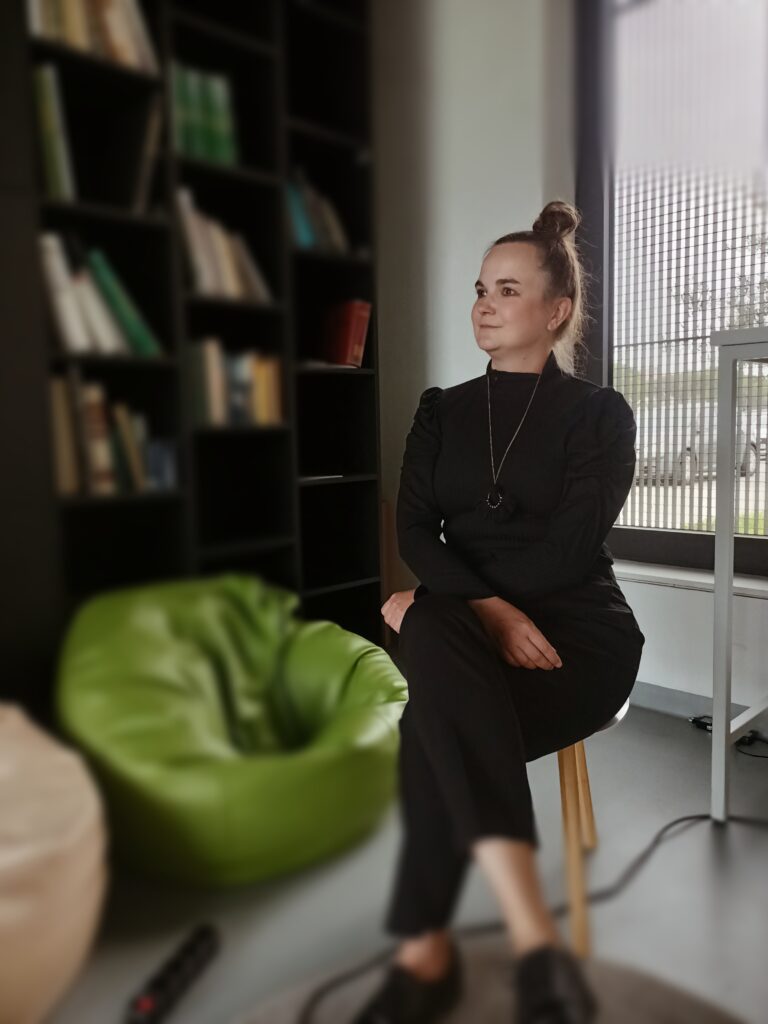
The project coordinator is: Monika Frania
Associate profesor at the Insitute od Pedagogy, University of Silesia in Katowice (Poland). Doctor of Humanities (2011). She completed master’s studies in pedagogy (2005) at the University of Silesia in Katowice at the Faculty of Pedagogy and Psychology and master’s studies in political science, specializing in journalism and social communication (2007) at the Faculty of Social Sciences.
Her research focuses on the broadly understood fields of media and education, with particular emphasis on media pedagogy and media literacy. Her academic interests also include communication, the use of new technologies in teaching and learning, children’s and young people’s information and media literacy, as well as the cultural and social dimensions of media, combining theoretical research with practical educational activities.
She is affiliated with the University of Silesia in Katowice, Poland. Throughout her academic career, she has led and participated in numerous national and international research, educational, and science-business collaboration projects. These include the New International Fellowship Mobility Programme for Experienced Researchers (NEWFELPRO) at the University of Split (Croatia), projects funded by the International Visegrad Fund, and research financed by the National Science Centre (NCN, Poland). She also participated in the Erasmus+ KA2 Strategic Partnership project Innovation and Transformation in Education (2019–2022), focused on cooperation for innovation and the exchange of good practices in school education.
She has completed long-term research fellowships and academic mobility programmes at the University of Madeira (Portugal), the University of Split (Croatia), the University of Primorska in Koper (Slovenia), and the University of Alicante (Spain). She has also undertaken short-term academic visits and collaborations with universities and educational institutions in Czechia, Slovakia, Hungary, Italy, Türkiye, Latvia, Lithuania, and Iceland.
In 2022, she received the TRANSFORM4EUROPE Innovative Teaching Award in recognition of her innovative educational practices. She collaborates with researchers and practitioners in media and digital education from numerous European universities.
She is the author and co-author of numerous scientific publications, a trainer, and an active contributor to national and international research and educational projects. She regularly presents her work at international and national scientific conferences.
Between 2016 and 2018, she served as a member of the Main Committee of the National Digital Olympiad for secondary school students, organized by the Modern Poland Foundation (Fundacja Nowoczesna Polska). She is actively involved in science communication and public engagement, promoting research through events such as the Silesian Science Festival, Meetings with Science and Student Life, the EduPozytywni Festival, the Festival Znanosti in Split (Croatia), and the Summer Science Exhibition in London (United Kingdom).
She collaborates with the Open University of Silesia as the Head of Postgraduate Studies for Teachers, a lecturer within the Teacher Education Block (BKN), and a trainer at the Centre for Didactics. She designs and delivers professional development courses on creative teaching methods, including storytelling, educational escape rooms, and self-care as a strategy for preventing teacher burnout. She also gives public lectures on her travel experiences and scientific expeditions across Europe.
She is a co-author of the academic programme for the international summer school Artificial Intelligence, Media and Storytelling in Modern Education, organized at the University of Alicante for education students from the University of Silesia.
Within the Institute of Pedagogy, she actively promotes and develops international cooperation and is the initiator of international scientific seminars. She also serves as the Dean’s Representative for Distance Education at the Faculty of Social Sciences.
Outside academia, she is passionate about independent travel to the remotest corners of Europe, searching for whales, the Northern Lights, cloud-filled volcanic calderas, dramatic cliffside trails, and ancient primeval forests.
ORCID: 0000-0002-2647-7363
Google Scholar
If you are interested in cooperation, we invite you to contact: monika.frania@us.edu.pl